Myths About Who Can't Use Hormone Therapy
A lot of women are still told they can’t use hormone therapy based on outdated information or one-size-fits-all rules. While there are definitely situations where hormone therapy isn’t appropriate, many women are actually turned away when they don’t need to be.
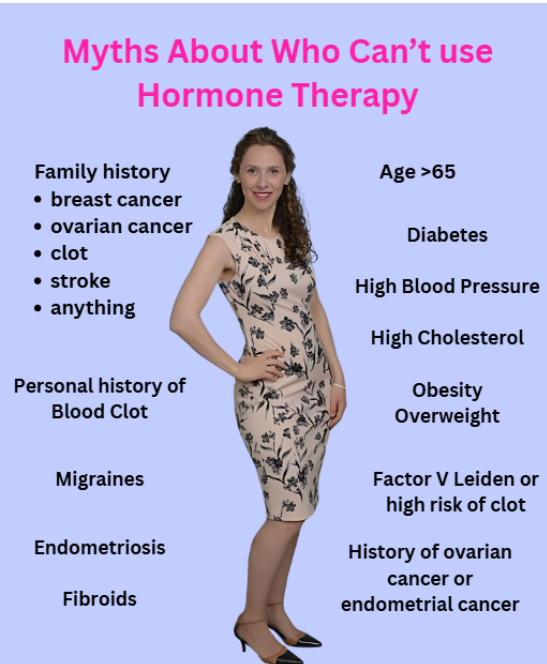
Myths About Hormone Therapy
Let’s walk through some of the most common myths.
MYTH 1: “If you have a family history of breast cancer, you can’t use hormones”
This is not true.
Having a family history of breast cancer is not an automatic reason to avoid hormone therapy. In the Women's Health Initiative, the relative risk of breast cancer with combined hormone therapy was similar whether or not women had a family history. What really matters is your overall personal risk profile, not just one relative’s diagnosis.
Even women with BRCA gene mutations, putting them at very high risk of breast cancer, who have had their ovaries removed may still be candidates for hormone therapy. Studies show that estrogen alone after preventive surgery does not increase breast cancer risk in BRCA carriers, and may even be protective. This is also reflected in major guideline recommendations.
MYTH 2: “You’re too old to start hormone therapy”
This is a really common misconception.
Age alone is not an automatic cutoff for hormone therapy. What we actually have are guidelines that recommend caution and individualized decision-making, especially after age 60 or more than 10 years past menopause. Organizations like the North American Menopause Society and ACOG also support continuing hormone therapy beyond age 65 when it’s appropriate and regularly reassessed.
And importantly—if someone is already on hormone therapy, there is no automatic age where they must stop. That decision should be based on how they’re feeling, the benefits they’re getting, and their individual risk profile.
MYTH 3: “If you’ve had a blood clot, you can never use hormones”
This isn’t always true.
The risk is mainly linked to oral estrogen (pills), which goes through the liver and can increase clotting factors. But transdermal estrogen (patches, gels, sprays) bypasses the liver and does not appear to increase blood clot risk.
Even in some women with a prior clot, transdermal estrogen has not shown an increased recurrence risk
Because of this, many guidelines, including ACOG, highlight that transdermal estrogen may be a safer option when estrogen is needed.
A history of a blood clot doesn’t automatically rule out hormone therapy—it just means we choose the right type and have a careful, individualized discussion.
MYTH 4: "You have heart disease risk factors, so you can't use hormones."
Having risk factors like high blood pressure, high cholesterol, diabetes, or obesity does not automatically rule out hormone therapy. It just means we choose and monitor it more carefully.
In these situations, we usually prefer transdermal estrogen (patches, gels) over pills. We make sure blood pressure and other risks are optimized.
The main situations where hormone therapy is generally avoided are recent or active heart attack, stroke, or unstable angina.
MYTH 5: "You get migraines, so you can't take hormones."
Migraines are not a reason to avoid menopausal hormone therapy. In fact, for many women, hormone therapy can actually help—because fluctuating estrogen levels are a common migraine trigger during menopause.
A few important points:
Migraine with aura slightly increases stroke risk based on older literature when women took oral contraceptive pills. In these cases, low-dose transdermal estrogen (patches or gels) is preferred over oral estrogen.
Steady dosing works better—continuous regimens are usually better than cyclical ones, since hormone swings can trigger migraines.
The estrogen doses used in menopause treatment are much lower than birth control pills, which is where much of the original concern came from.
Most women with migraines can still use hormone therapy safely, and low-dose patch estrogen is often the preferred option, as supported by the North American Menopause Society.
MYTH 6: "You're overweight, so hormone therapy is too risky."
Obesity is not a contraindication to hormone therapy, but it does influence which type we choose.
Oral estrogen (pills) can increase blood clot risk more in women with higher body weight. For this reason, we use transdermal estrogen (patches, gels, sprays), which do not appear to increase clot risk, even in women with obesity.
Hormone therapy can even reduce some of the menopause-related shifts toward abdominal (belly) fat.
What ARE the True Reasons to Avoid Hormone Therapy?
Personal history of active hormone-receptor-positive breast cancer
Active or recent heart attack or stroke
Active blood clots (DVT or pulmonary embolism) — though transdermal may be considered in some cases after treatment especially if on a blood thinner
Unexplained vaginal bleeding (until evaluated)
Active liver disease
Known clotting disorders (protein C, protein S, or antithrombin deficiency)
